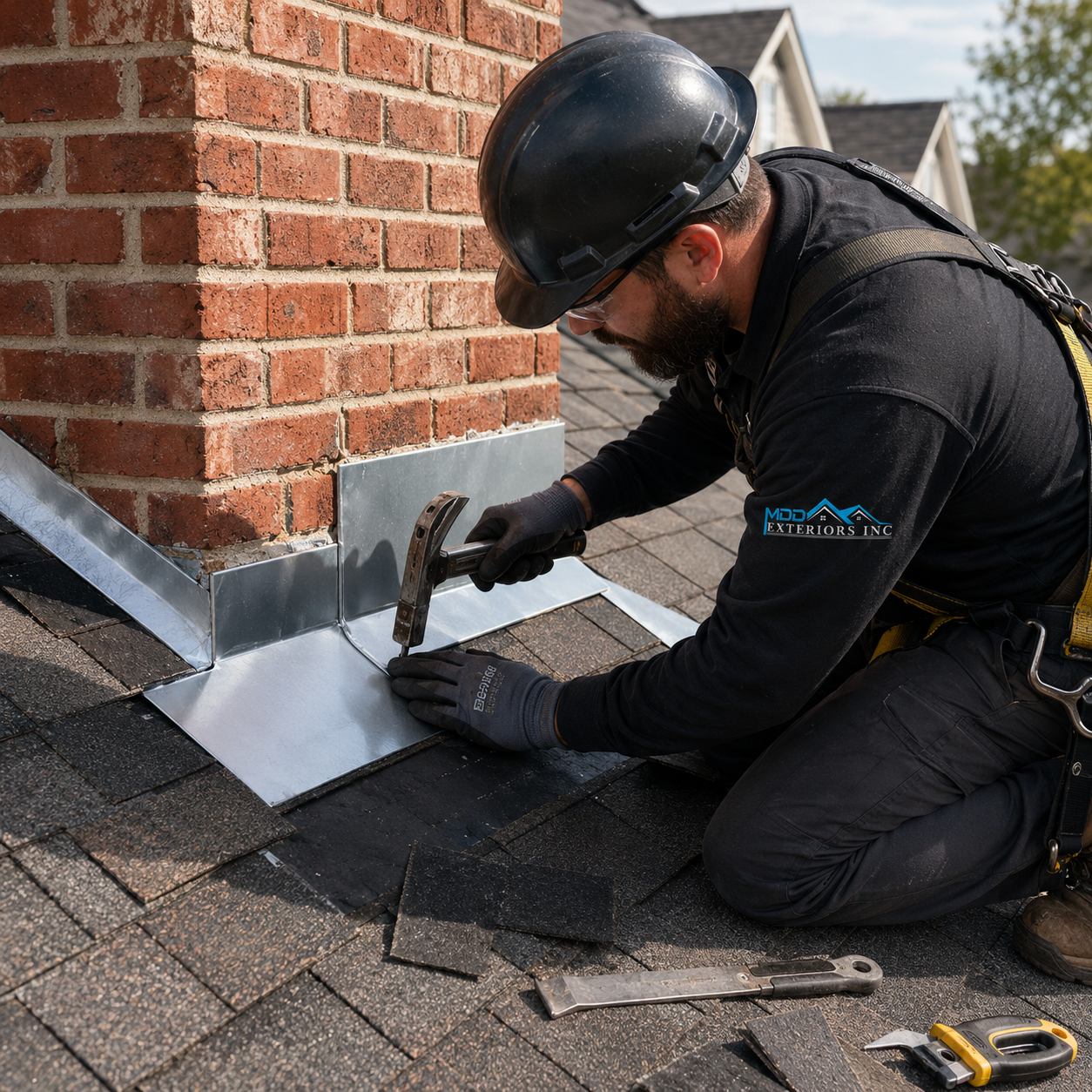
Roof flashing repair is a roofing service for correcting damaged, loose, corroded, or missing flashing around chimneys, skylights, roof vents, walls, valleys, and roof penetrations. Damaged flashing allows water intrusion into roofing materials, attic spaces, ceilings, insulation, wall assemblies, and structural components.
MDD Exteriors is a licensed residential and commercial roofing contractor that repairs flashing systems for homeowners, commercial property owners, property managers, and multifamily properties. The company's roofing team inspects flashing-related leak points and repairs compromised roof transition areas.
Call +1 (866) 310-7663 for Roof Flashing Repair
Flashing repair services from MDD Exteriors address flashing failures at chimneys, skylights, roof vents, masonry intersections, roof-to-wall junctions, valleys, and roof penetrations. Flashing installed at those locations directs water away from vulnerable roof connections and helps protect roofing materials from moisture intrusion.
MDD Exteriors commonly repairs corroded metal flashing, separated flashing sections, failed sealant, damaged vent collars, cracked pipe boots, loose fasteners, and deteriorated flashing edges. Water entering through damaged flashing often travels beneath shingles, reaches underlayment layers, and exposes roof decking to ongoing moisture exposure. Corrective work uses galvanized steel flashing, aluminum flashing, roofing cement, flashing sealant, and roofing nails to restore watertight seals at confirmed leak-entry points.
Roof flashing repair is often required when leak activity develops around roof penetrations, masonry intersections, skylights, roof vents, or roof-to-wall connections.
Leak activity associated with damaged flashing rarely remains confined to a single location. MDD Exteriors evaluates flashing condition, surrounding roofing materials, roof decking exposure, and adjoining roof connections to isolate leak-entry locations before deterioration spreads into additional roof sections.
| Symptom | Likely Flashing Issue | Urgency | What MDD Inspects |
|---|---|---|---|
| Ceiling stains near chimney | Failed step flashing or counter flashing | High | Step flashing integration, counter flashing seams, mortar joints |
| Leaks near skylight perimeter | Deteriorated skylight flashing or failed sealant | High | Skylight frame seal, flashing edges, surrounding shingles |
| Moisture around roof vent | Cracked pipe boot or failed vent collar | Medium | Pipe boot condition, collar seal, surrounding underlayment |
| Interior leaks following storms | Loose or missing flashing sections | High | Flashing fasteners, separation points, adjacent roof deck |
| Rusted metal visible on roof | Corroded galvanized or aluminum flashing | Medium | Corrosion extent, water travel path, adjacent roofing materials |
| Leaks in roof valley area | Damaged or separated valley flashing | High | Valley flashing channel, shingle overlap, drainage path |
MDD Exteriors repairs flashing installed around chimneys, skylights, roof vents, plumbing stacks, dormers, roof valleys, parapet walls, rooftop equipment, roof-to-wall junctions, and commercial roof penetrations.
Chimney flashing repairs often involve step flashing integrated with roofing materials, counter flashing installed at masonry surfaces, and base flashing positioned at roof-level transitions. Vent flashing repairs frequently involve pipe boot flashing surrounding plumbing penetrations where movement and weather exposure contribute to deterioration. Valley flashing repairs address metal channels responsible for directing water through intersecting roof slopes during heavy rainfall.
MDD Exteriors assesses repair requirements according to flashing condition, roof design, drainage patterns, weather exposure, penetration density, material type, and accessibility of the affected roof area.
Residential flashing failures on sloped roofing systems often develop gradually. Corrosion and sealant failure at chimney and skylight intersections frequently go undetected until interior ceiling stains or attic moisture appear. MDD Exteriors inspects residential flashing connections, documents deficient locations, and repairs failing components before water reaches the roof deck.
Commercial roof flashing repair from MDD Exteriors addresses deteriorated flashing surrounding parapet walls, rooftop equipment, mechanical penetrations, drains, expansion joints, equipment curbs, and building-envelope transition points.
MDD Exteriors repairs flashing at rooftop equipment curbs, parapet wall transitions, mechanical penetrations, expansion joints, and drainage assemblies where water management depends on properly functioning flashing components. Large commercial roofing systems frequently contain numerous flashing locations distributed across multiple roof sections. The company documents flashing deficiencies, identifies confirmed leak-source locations, and develops corrective repair strategies aligned with observed site conditions.
Flashing repair costs range from $150 to $400 for minor corrective work and increase based on flashing location, roof accessibility, repair complexity, material condition, and the number of damaged components requiring corrective work.
Often involves masonry intersections, counter flashing, base flashing, and multiple transition points.
Frequently involves vent collars, pipe boots, and mechanical penetrations.
Often involve parapet walls, rooftop equipment, expansion joints, drainage assemblies, and larger roof areas requiring broader evaluation.
MDD Exteriors provides project-specific pricing after evaluating roof conditions and confirmed repair requirements. Chimney flashing repairs, parapet wall work, and commercial penetration repairs carry higher costs based on scope, material type, and roof access.
Property owners choose MDD Exteriors for roof flashing repair based on documented site conditions, confirmed leak-entry locations, and repair options delivered before work begins.
Property owners receive documented flashing deficiencies, identified leak-entry locations, repair priorities, and corrective options before work begins. The company bases repair decisions on observed roof conditions and confirmed flashing failures, not on assumptions about water intrusion sources. MDD Exteriors addresses damaged flashing components, confirmed leak paths, and affected roof connections in every completed repair.
Schedule roof flashing repair with MDD Exteriors to identify damaged flashing components, review available repair options, and address flashing-related leak sources before deterioration affects additional roof areas. Annual roof inspections from MDD Exteriors detect early-stage flashing failures before active leaks develop.